

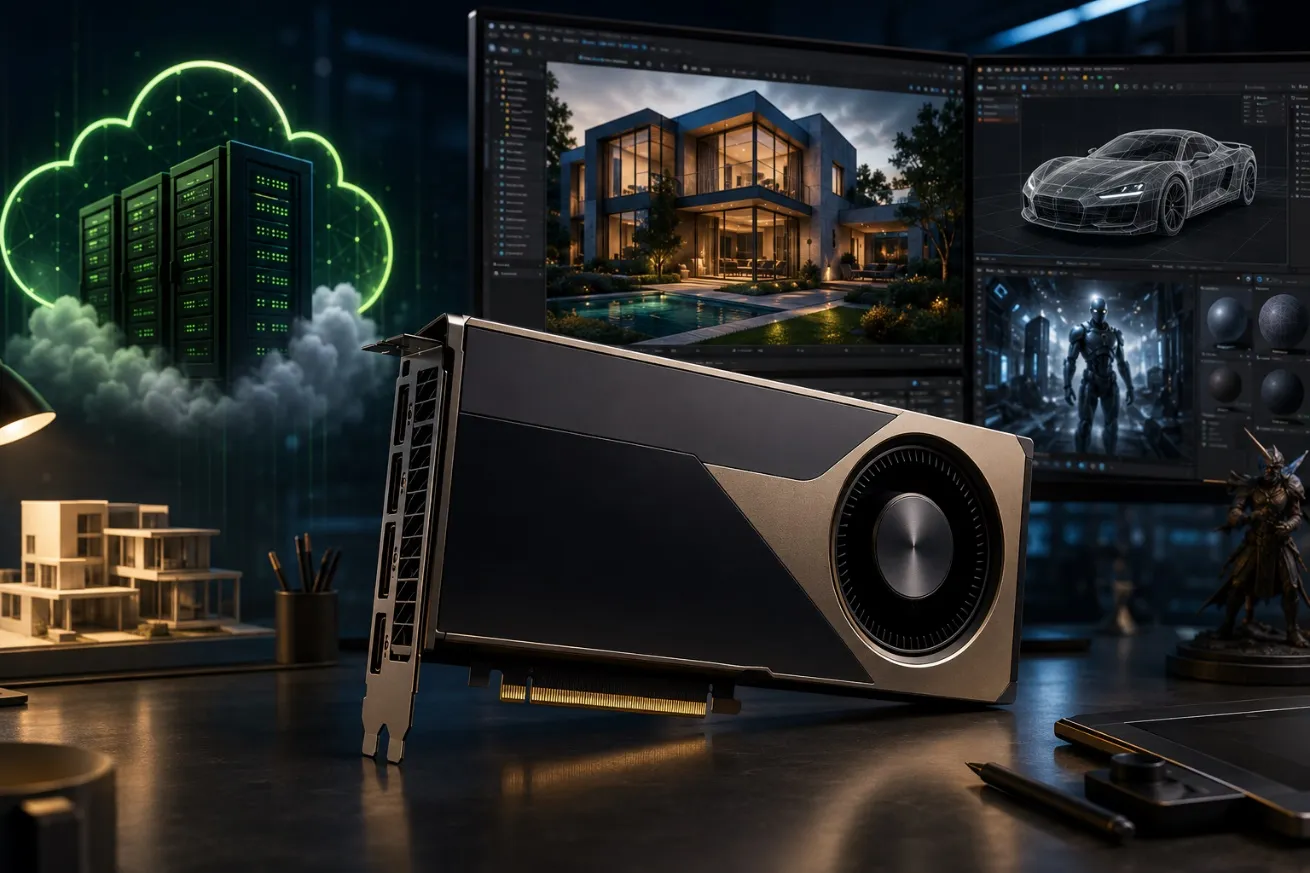
The need for fast graphics processing hardware is huge and ever-expanding – whether the task at hand is a complex 3D architecture or animation, visualising designs of the newest products or rendering some spectacular VFX effects in a movie. In the landscape of high-end, cutting-edge rendering studios, one hardware solution that is likely to make a huge impact on 3D rendering in 2026 is the rtx pro 6000.
Designed around NVIDIA’s next-generation Blackwell platform, the RTX Pro 6000 was designed to empower professionals who rely on render-intensive workflows, graphics-based operations, and AI-based computations. The Pro version has been equip with GDDR7 ECC RAM as it now totals 96 GB of it. This comes with ray tracing advancements and considerable AI power to manage a demanding workload.
But does that make it the best professional GPU for 3D rendering studios in 2026? Let’s dig in on what it does and why creatives prefer to subscribe to cloud-hosted tools such as those at CloudPe.
The Growing Demands of Modern 3D Rendering
Rendering projects have become significantly more complex over the past few years. Currently, a lot of work goes into a photorealistic lightning render. Studio artists are now dealing with even bigger than ultra-high resolution texture files, a far better quality of particles, and more advanced AI-driven effects.
Applications such as Blender, Autodesk Maya, Cinema 4D, Houdini, Unreal Engine, and OctaneRender require substantial GPU resources to maintain productivity. Artists expect real-time viewport performance while simultaneously rendering complex scenes in the background.
Meeting those needs means studio gear has to be the sum of compute performance, memory capacity, and dependability.
Massive Memory for Complex Scenes
One of the defining advantages of the rtx pro 6000 is its impressive 96 GB of GDDR7 memory with ECC support. This large memory pool allows artists to work with extremely detailed assets without constantly optimising or simplifying scenes to fit GPU limitations.
Cinematic scene creation, architectural projects, engineering simulations, and virtual production can all see major gains with more GPU memory. Teams no longer need to break up projects into several render passes, keeping the whole scene in GPU memory.
For studios handling high-end visual effects or feature animation, this capability translates directly into saved production time.
Exceptional Ray Tracing Performance
Photorealistic rendering depends heavily on ray tracing technology. The RTX Pro 6000 includes fourth-generation RT Cores that significantly improve ray-tracing throughput compared with earlier workstation generations. NVIDIA positions it for demanding rendering and graphics workloads requiring real-time and offline ray tracing.
This gives the artists the opportunity to visualize realistic shadows, lighting effects, reflection, and global illumination much earlier during the scene development process. Instead of waiting a very long time to create a preview render, the designers will be able to do their creative choice instantly.
The result is faster iteration cycles and improved collaboration between artists and clients.
AI Acceleration Is Becoming Essential
Artificial intelligence is transforming creative production. AI-powered denoising, texture generation, animation assistance, and scene optimisation are increasingly integrated into professional software.
Featuring fifth-generation Tensor Cores, the rtx pro 6000 delivers accelerated performance in AI workloads and enhances graphics with intelligent rendering effects and machine learning capabilities.
For studios experimenting with generative design or AI-assisted content creation, these capabilities provide valuable future-proofing as software continues to evolve.
Better Performance for Multi-Application Workflows
Creative professionals rarely use a single application. The standard pipeline might entail the use of different programs to model, texture, and composite, as well as the use of a specialised rendering program.
The RTX Pro 6000 is designed to support these demanding multitasking environments without becoming a bottleneck. High compute throughput and substantial memory help maintain responsiveness across multiple GPU-intensive workloads.
Working with a single workspace saves on time wasted and eliminates constant app switching, whether you’re editing assets in a render or training your AI models while you work.
Reliability Matters for Professional Studios
Unlike consumer gaming GPUs, workstation-class hardware prioritises stability and consistency for business-critical environments.
Features such as ECC memory support help reduce the risk of memory-related errors during long rendering sessions, while professional drivers are optimised for certified creative and engineering applications. According to NVIDIA, ECC-enabled 96 GB GDDR7 memory and the professional workstation use case stand apart from other factors of the RTX Pro 6000 platform.
Reliability can be as important as sheer power to studios tied to strict deadlines.
Why Cloud Access Is Becoming More Attractive
Purchasing flagship workstation GPUs requires a substantial capital investment. Additional considerations in the total cost of ownership are Hardware Availability, Hardware Maintenance, Cooling, Future Upgrades, etc.
This is why many studios are shifting toward GPU cloud platforms instead of building large on-premises render farms.
CloudPe provides creative teams with access to the hardware at a price of the company, as with the GPU power of the enterprise, while with the latter, CloudPe provides on-demand GPU infrastructure, so studios could adjust performance according to your project needs, instead of buying an over-priced server. This would help studios to expand the rendered amount of time for more projects in busy months, while minimizing your expenditure on hardware during the off-peak periods.
For freelancers, agencies, and growing production houses, cloud GPUs also eliminate concerns about hardware depreciation and maintenance.
How CloudPe Helps Creative Professionals
CloudPe provides access to high-performance GPU infrastructure designed for compute-intensive workloads such as rendering, AI development, simulation, and visual effects.
Using on-demand GPU infrastructure in the cloud means:
- Create large-scale productions without buying any hardware.
- Scale GPUs based on production needs.
- Enable artists to work remotely from anywhere.
- Reduce infrastructure management overhead.
- Accelerate delivery timelines for demanding client projects.
Instead of patiently waiting for a local hardware upgrade team, the team was provisioned for GPU resources at their disposal when more rendering performance was needed.
Is RTX Pro 6000 the Right Choice for Every Studio?
The answer depends on workload requirements. For those working on smaller projects with simple asset sets, a cheaper professional GPU might do fine. If your work is at the level of the kind produced in feature film animation, VR, architectural visualization, engineering simulations, or for advanced AI creative content, your work deserves the speed and power of the rtx pro 6000.
Its combination of substantial memory capacity, advanced ray tracing hardware, AI acceleration, and workstation reliability makes it particularly well-suited for demanding production environments where performance directly impacts delivery schedules.
Final Thoughts
The 2026 rtx pro 6000 is one of the highest-performing professional graphics processors ready for 3D rendering or creative workloads. NVIDIA has made a strong case that for anyone working on some seriously demanding visuals with that studio that needs high-performing creative technology, its architecture, 96-gigabyte memory capacity with GDDR7 and ECC, next-gen RT Cores, and AI performance for its Tensor Cores will serve that market well into the future.
However, owning cutting-edge hardware is not the only path to high performance. Through CloudPe, businesses and creative professionals can access enterprise-grade GPU power in the cloud, giving them the flexibility to scale rendering workloads without the significant upfront investment of purchasing workstation hardware.
For studios seeking speed, scalability, and cost efficiency, combining cloud infrastructure with the capabilities of the rtx pro 6000 can provide a competitive advantage in an increasingly demanding creative industry.